



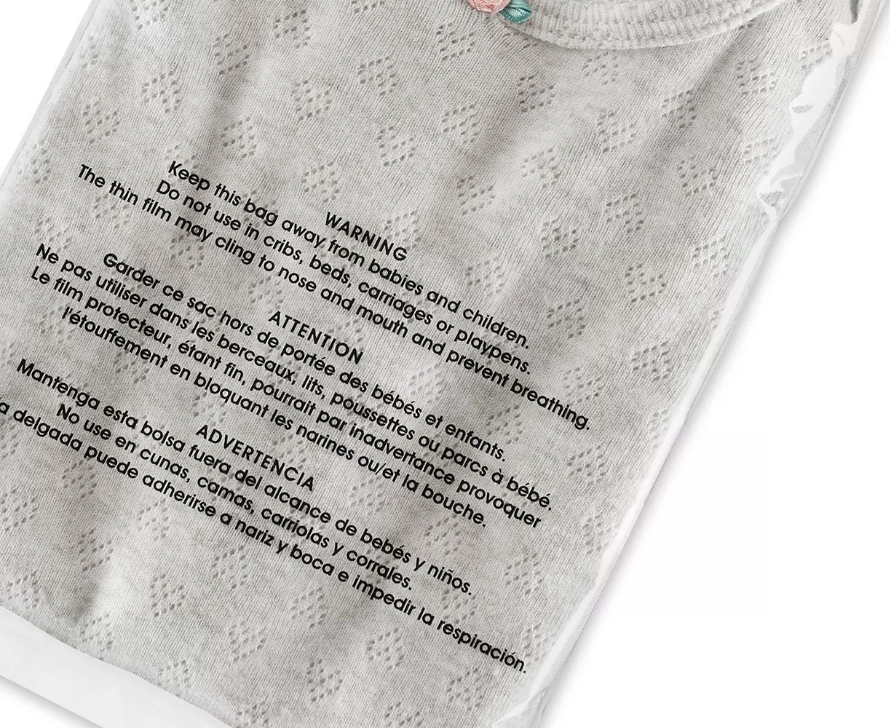
Most of what's written about suffocation warning bags is about the warning — the text, the languages, the 5-inch rule. That's the part Amazon checks, and our FBA requirements guide covers it in detail. This post is about the part almost nobody writes about: the size.
A bag that's too tight tears at the seal or won't close. A bag that's too loose swims, folds film over the barcode, and wastes material you paid for. Both end up re-bagged, and re-bagging is billed at the prep center's rates.
How warning bags are measured
Flat bags are sized width × length in inches, measured flat. Width runs across the opening; length runs from the bottom seal to the opening. A 9 × 12 bag is 9 inches across the mouth and 12 inches deep.
The same measurement decides whether the warning is required: a bag 5 inches or larger needs it printed. In practice that's nearly every size on the list below — even the smallest stock size, 5 × 7, crosses the threshold.
Sizing a bag to a product
Measure the product the way it actually goes into the bag — folded, boxed or stacked — not the way it looks on its spec sheet. Then add allowance:
- Width: add the product's thickness plus a little slack — about an inch for a folded garment.
- Length: add the thickness plus 1.5 to 2 inches for the bottom seal and the self-seal lip, so the bag closes flat instead of straining.
- Soft goods compress; rigid goods don't. A folded tee tolerates a snug bag. A boxed item with corners needs the full allowance, or it stresses the seams.
The 22 stock sizes
Our stock warning bags are 1.5 mil clear poly with the standard warning printed in English, Spanish and French, vent holes, and a self-seal closure. Stock ships from a single case. Grouped, with typical uses:
- Small goods — 5 × 7, 6 × 6, 6 × 9, 7 × 10: accessories, jewelry, socks, single cosmetics.
- Folded apparel — 6 × 12, 8 × 10, 8 × 12, 9 × 12, 10 × 12: tees, leggings, folded kids' clothing.
- Bulkier soft goods — 10 × 15, 11 × 14, 12 × 12, 12 × 15, 12 × 16: hoodies, sweaters, bundled sets.
- Large items — 12 × 18, 14 × 18, 14 × 20, 16 × 20: jackets, bedding sets, blankets.
- Oversize — 16 × 24, 18 × 24, 20 × 20, 22 × 24: comforters, pillows, large bundles.
When the stock size is the wrong size
Stock sizes step in fixed increments, and a product that falls between two of them pays for the jump. If a SKU ships in volume and sits awkwardly between sizes, the right answer is usually the size that fits. We extrude, print and convert under one roof, so custom sizes and custom warning layouts are quoted per run; custom-printed runs start at 50,000 pieces per artwork.
Why an oversized bag costs more than it looks
Film is bought by weight, and a bag's film weight scales with its area. A 12 × 15 bag has 180 square inches per face; a 10 × 12 has 120. At the same gauge, that's half again as much film in every bag — before counting the dimensional weight of a bigger parcel.
Send us the product dimensions — or the product — and your monthly volume, and we'll tell you whether a stock size fits or a custom one pays for itself. We quote in 24 business hours.