


A poly bag is Amazon FBA compliant when it meets the published requirements: film at least 1.5 mil thick, the standard suffocation warning printed on any bag measuring 5 inches or larger, punched vent holes visible with the product inside, and an FNSKU barcode that still scans clear of the warning print. None of it is complicated, and it fits on one page; Amazon just never puts it on one page.
This is that page. Five requirements decide whether a poly bag is FBA compliant: the film thickness, the warning text, the vent holes, when the warning is required at all, and whether the barcode still scans. Here's each one, in production terms.
The 1.5 mil rule
Amazon requires poly bags to be at least 1.5 mil thick. Thinner film is considered too fragile to safely hold a product and its printed warning through the FBA handling chain, and it fails inspection.
The production detail that matters: 1.5 mil is a minimum, not a target. Film gauge varies across the web of every extrusion run, so a bag spec'd at exactly 1.5 mil with a loose tolerance will have patches below spec. Ask your supplier for the gauge tolerance, not just the gauge — a 1.5 mil bag held to ±5% stays compliant at its thinnest point.
The suffocation warning: exact text, size, and languages
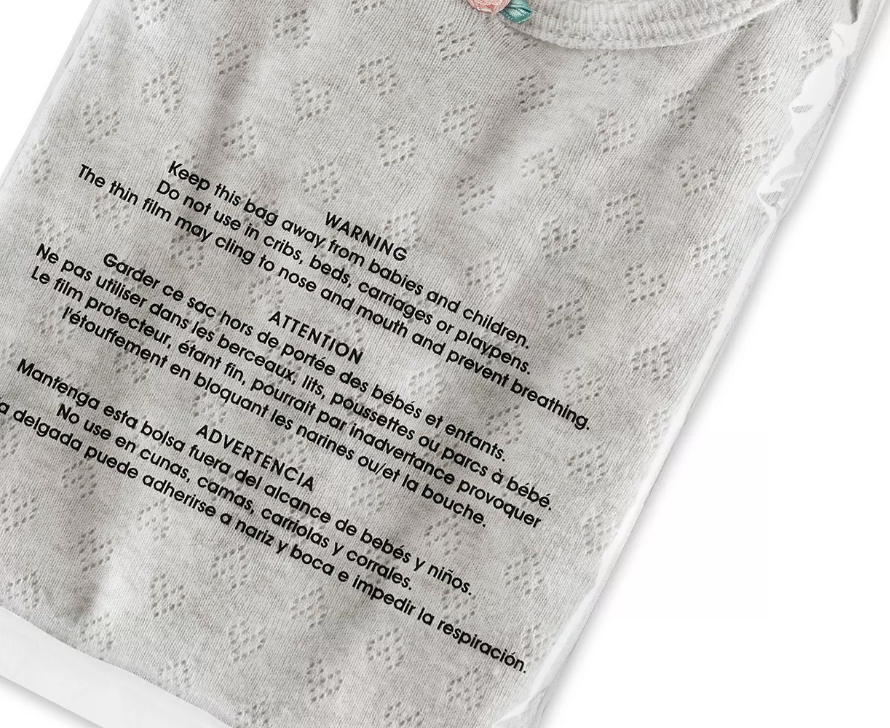
Any poly bag that needs a warning (the 5-inch rule below decides which do) must carry the standard suffocation warning: “WARNING: To avoid danger of suffocation, keep this plastic bag away from babies and children. Do not use in cribs, beds, carriages, or playpens. This bag is not a toy.”
Print size scales with the bag: roughly 24-point type for bags over 25 inches of combined length and width, 18-point for 15 to 25 inches, and 10-point below that. The text must be legible and printed in a contrasting color — black on clear film is the standard.
Amazon's US policy requires English. The practical North American standard is English, Spanish, and French on the same bag — it covers Canadian marketplace listings, bilingual state markets, and any future channel without a re-run. That trilingual print is our default.
Vent holes
A sealed poly bag that can inflate is itself a suffocation hazard, so FBA bags carry vent holes — a punched pattern, not a single hole, sized so the bag genuinely cannot hold air against a child's face. The holes have to be present and visible with the product inside the bag.
Vent holes are punched at conversion, which means they're a spec line on the bag, not something a prep center adds later. A bag that arrives unvented gets re-bagged at your expense.
The 5-inch rule
Not every poly bag needs the warning. Amazon's threshold is 5 inches: a bag measuring 5 inches or larger requires the printed suffocation warning. Below that, the bag is too small to be a suffocation hazard and ships warning-free.
In practice, almost everything except jewelry pouches and small-parts bags crosses the threshold. If you're bagging apparel, textiles, or any boxed-adjacent consumer product, assume the warning applies — and if a SKU sits near the line, print it anyway. There is no penalty for a warning on a small bag; there is one for a missing warning on a big one.
State laws don't stop at the FC door
The suffocation warning isn't only an Amazon rule. California, New York, Massachusetts, Virginia, and Rhode Island each have laws requiring warnings on thin plastic bags used with consumer goods — and those laws apply to anything you sell into those states, on any channel, whether or not Amazon ever inspects the bag.
This is why the warning bag is worth standardizing across your whole operation, not just the FBA lane. One compliant bag covers Amazon, the five state statutes, and every other marketplace's polybag policy at once — and removes the failure mode where the FBA-compliant SKU and the everything-else SKU get mixed at the pack station.
What a rejection actually costs
The bag is the cheapest item in the chain, which is what makes failing on it expensive. When a shipment arrives non-compliant, Amazon either re-bags it as an unplanned prep service — billed per unit, at many multiples of what the bag cost you — or marks the inventory unfulfillable, where it sits stranded until you file a removal order and pay return freight.
The bill nobody itemizes is time. Stranded inventory is inventory not selling: a compliance rejection during Q4 can take a SKU off the shelf for weeks while the removal, re-bag, and re-inbound cycle runs. Against that, the delta between a compliant bag and a cheap one rounds to zero.
How to spec a compliant bag
Put these lines on the purchase order and you've removed the guesswork:
- Film: clear polyethylene, 1.5 mil minimum — ask for the gauge tolerance in writing.
- Warning: the standard suffocation warning text, sized to the bag perimeter, in English, Spanish, and French.
- Vent holes: punched pattern, visible with product inside.
- Closure: self-seal lip — fast at the pack station, no heat sealer required.
- Size: just larger than the product. An oversized bag flags Amazon's review and bloats your dim weight.
- Barcode: confirm the FNSKU label placement clears the warning print, with a quiet zone around the code.
Stock vs. custom-printed: when the 50,000-unit question comes up
For most sellers, the answer is stock. A stock suffocation warning bag already carries the compliant print, ships from one case, and comes in enough sizes — 5×7 through 22×24 — to fit nearly any product. You can be FBA compliant this week without a minimum-order conversation.
Custom-printed becomes the right call when you want your brand, SKU information, or a single-language warning on the bag alongside the compliance print. That's a plate-and-press run, and it starts at 50,000 units — the point where the print setup stops dominating the unit price. Below that volume, run the stock bag and put the brand on the mailer instead; above it, the custom bag usually costs about what the stock one does.
That's the whole spec: 1.5 mil, the exact warning in three languages, vent holes, the 5-inch threshold, and a barcode that scans. A supplier who builds bags to it — instead of selling you “FBA-ready” and hoping — should be able to answer for every line above with a number. Ours are on the product page, and the quote takes 24 business hours.
SOURCES
- Packaging and prep requirements — Amazon Seller Central
- Synergy Packaging FAQ — MOQs, lead times, and FBA compliance — Synergy Packaging
Frequently asked questions
- How thick does a poly bag need to be for Amazon FBA?
- Amazon requires poly bags to be at least 1.5 mil thick. That is a minimum, not a target, because film gauge varies across every extrusion run, so ask the supplier for the gauge tolerance in writing; a 1.5 mil bag held to plus or minus 5% stays compliant at its thinnest point.
- Does every Amazon FBA poly bag need a suffocation warning?
- No, only bags measuring 5 inches or larger need the printed suffocation warning; below that, the bag ships warning-free. In practice almost everything except jewelry pouches and small-parts bags crosses the threshold, and there is no penalty for a warning on a small bag, so print it if a SKU sits near the line.
- What happens if my FBA shipment arrives in non-compliant poly bags?
- Amazon either re-bags the units as an unplanned prep service billed per unit, or marks the inventory unfulfillable, where it sits stranded until you file a removal order and pay return freight. A compliance rejection during Q4 can take a SKU off the shelf for weeks while the removal, re-bag, and re-inbound cycle runs.