



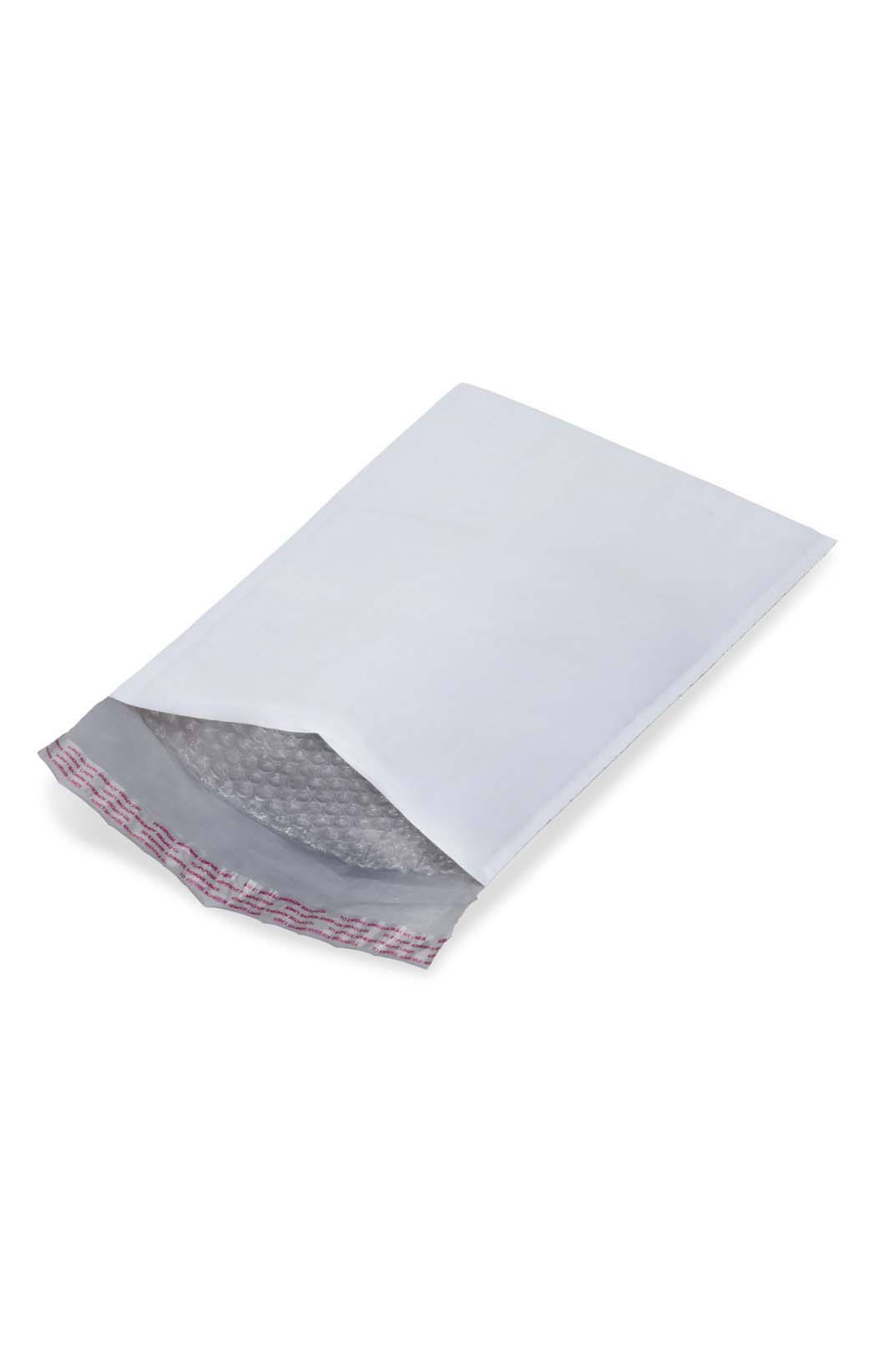
Padded envelope, padded mailer, and bubble mailer are almost always the same product: a shipping envelope with a printable outer face bonded to an interior cushioning layer and a self-seal flap. The name usually tells you who is selling it, and the only place it signals a real difference is the face material, poly or kraft.
Here's the thing underneath the names: what's genuinely the same, the one axis where a name change does signal a different product, the size system that actually matters, and the five spec lines that decide what you're buying — so the next quote is a comparison of bags, not of vocabulary.
The names, decoded
Almost all of these terms point at the same object: a shipping envelope with a printable outer face bonded to an interior cushioning layer and a self-seal flap. The name usually tells you who's selling it, not what it is.
- Padded envelope / padded mailer — the generic term. "Padded" is the function (there's cushioning inside); it doesn't specify what the padding is.
- Bubble mailer / bubble envelope — a padded mailer whose cushioning is specifically an air-bubble film. This is the modern default, and the vast majority of "padded mailers" sold today are bubble-lined.
- Cushioned mailer — same product, softer marketing word. No spec difference.
- Kraft mailer — a padded/bubble mailer with a kraft-paper outer face (as opposed to a poly face). Here the name is finally pointing at something real — the face material — which is the one axis worth slowing down on.
- Jiffy bag / jiffy mailer — a brand name that became a generic term, like calling every tissue a Kleenex. Historically it meant paper-padded (macerated recycled paper) rather than bubble; today it's used loosely for any padded mailer.
The one place the name signals a real difference: the face
Strip away the synonyms and there's exactly one axis where switching names means switching products — the outer face. That's the choice worth making deliberately, because it's the one that changes cost, look, and recyclability. A padded mailer's face comes in four common builds:
- Poly bubble — a coextruded poly film face over the bubble lining. Water-resistant, opaque, prints clean and glossy, the lightest option. The e-commerce default.
- White kraft — a bright white paper face for a premium, printable, paper-forward look. Recyclable curbside where the liner allows.
- Natural kraft — the classic brown paper face. Utilitarian, inexpensive, reads "honest."
- Natural recyclable kraft — a paper face paired with a curbside-recyclable construction, for brands making a sustainability claim they need to stand behind.
Two mailers can be identical in size and cushioning and still be a poly bubble mailer and a kraft mailer — genuinely different products for different jobs. That's the distinction the naming actually hides. (The deeper kraft-vs-poly trade-off — moisture, weight, recyclability, print — is its own decision; the short version is poly for water resistance and lowest weight, kraft when the paper look or a curbside-recyclable story matters.)
The one thing "padded" never tells you: is it bubble or paper?
"Padded" is a function, not a material — and the material matters. The two fillings you'll actually meet are air-bubble film and macerated paper (the gray shredded-paper padding in old-style jiffy bags). Bubble is lighter, cleaner to pack, cushions better per gram, and doesn't shed paper dust into the product. Paper padding is heavier, messier, and mostly a legacy format.
So when a listing just says "padded mailer," the real question is which padding — and for nearly every modern shipping job, the answer you want is bubble. If you're comparing a cheap "padded envelope" against a bubble mailer, you may be comparing paper fill against air fill without the listing ever saying so.
The size system: #000 through #7 (plus CD)
Whatever the seller calls the bag, padded and bubble mailers share one standardized size ladder — a numbered system that runs from #000 (the smallest) up to #7, plus a dedicated CD/disc size. Knowing the number is how you compare a "padded envelope size 2" from one vendor against a "bubble mailer #2" from another: they're the same footprint.
The anchor points of the standard chart, as inside (usable) dimensions:
- #000 — about 4" × 8": jewelry, small parts, cosmetics samples.
- #0 — about 6" × 10": phone cases, small electronics accessories.
- #2 — about 8.5" × 12": books, apparel folded small, mid-size accessories.
- #5 — about 10.5" × 16": boxed goods, bulkier apparel, multi-item orders.
- #7 — about 14.25" × 20": the large end — framed items, larger soft goods.
- CD — a purpose-sized pocket for discs and similarly flat, rigid small items.
The sizing rule is the same one that governs every mailer: size to the product, not up. An oversized padded mailer adds slack the carrier bills as dimensional weight, and lets the product shift inside the cushioning it was supposed to sit snug in. The full #000–#7 chart lives on the product page; match the number to the SKU and the naming stops mattering.
The spec sheet that actually decides it
Ignore the name on the listing. These five lines are what you're really buying, and any supplier worth quoting can answer all five with a value:
- Face material — poly bubble, white kraft, natural kraft, or recyclable kraft. This is the real product decision.
- Cushioning — air-bubble lining (what you almost certainly want) vs. legacy paper padding.
- Size — the # from the standard ladder (or a custom footprint), sized to the product with minimal slack.
- Closure — self-seal peel-and-press flap is the standard; it packs fast with no tape or heat.
- Print — blank stock, or your brand across the face. Stock ships from one case; custom-printed runs start at 50,000 units, the point where plate-and-press setup stops dominating the unit price.
And the line no name reveals: where it's made
The one spec that never appears in any of these names is origin — and in 2026 it's the one that moves the landed cost most. A padded mailer imported under tariff lands at a very different number than the quoted unit price suggests; a USMCA-compliant one made nearshore crosses the border duty-free, in days rather than weeks on the water.
We make bubble mailers in Tijuana in all four faces — poly bubble, white kraft, natural kraft, and natural recyclable kraft — across the full #000–#7 ladder plus CD, self-seal as standard. Stock sizes ship from one case; custom print starts at 50,000 units. Send the size (or the product, and we'll size it), the face you want, and quantities — we quote in 24 business hours. Call it a padded envelope, a padded mailer, or a bubble mailer; we'll build the same right bag either way.
SOURCES
- Synergy Packaging FAQ — bubble mailer faces, sizes, MOQs, and lead times — Synergy Packaging
- Bubble mailer sizes explained: the #000–#7 chart and how to choose — USMEX Nearshore (sister plant, Tijuana)
Frequently asked questions
- Is a padded envelope the same thing as a bubble mailer?
- Mostly yes. A bubble mailer is a padded mailer whose cushioning is specifically an air-bubble film, and the vast majority of padded mailers sold today are bubble-lined. The exception is the legacy paper-padded mailer (macerated recycled paper), which is heavier, messier, and sheds paper dust into the product.
- What size is a #2 bubble mailer?
- A #2 bubble mailer measures about 8.5 by 12 inches inside, which fits books, apparel folded small, and mid-size accessories. The standard ladder runs from #000 (about 4 by 8 inches) up to #7 (about 14.25 by 20 inches), plus a CD size, and the number means the same footprint whether a vendor calls it a padded envelope or a bubble mailer.
- What is the difference between a kraft mailer and a poly bubble mailer?
- The difference is the outer face: a kraft mailer has a paper face and a poly bubble mailer has a coextruded poly film face, over the same bubble lining. Poly is water-resistant, opaque, and the lightest option; kraft is the choice when the paper look or a curbside-recyclable story matters.