



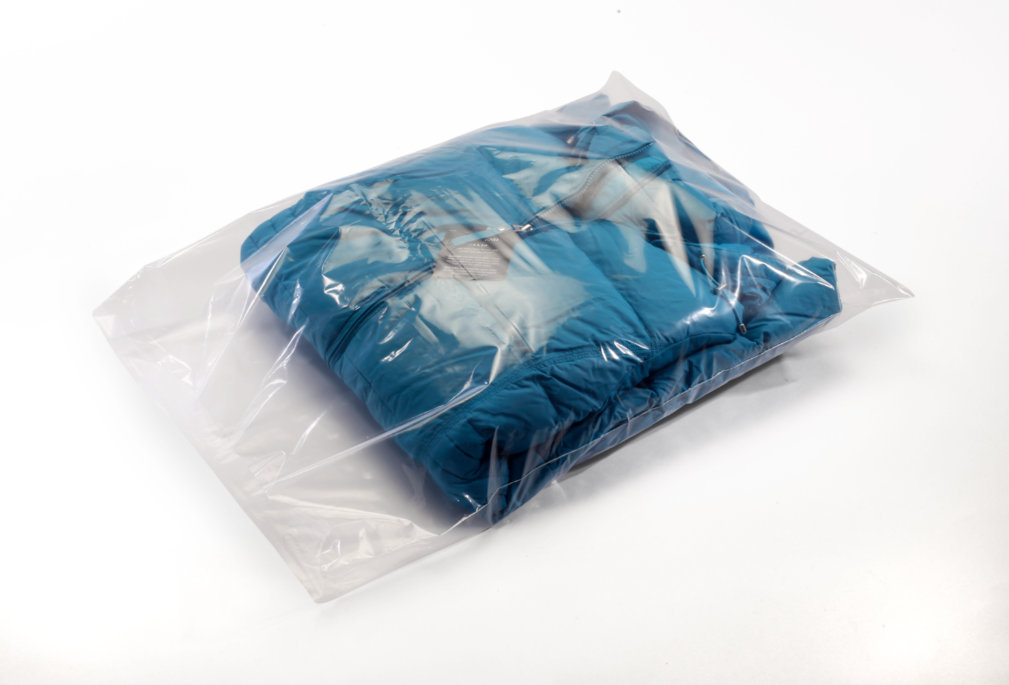
It is the least complicated bag there is: clear layflat polyethylene, open mouth, no lip, no adhesive strip. What makes it a distinct product is how it is packed — bags perforated end to end on a roll, so a packing station tears one off the way you tear a bag off the roll in a grocery produce aisle, scaled up and toughened for fulfillment.
What we make, and what we don't
Straight answer first, because you probably arrived here looking for a supplier: we do not currently run bags on a perforated roll. We extrude, print and convert flat and gusseted poly bags, suffocation warning bags, poly mailers, bubble mailers and bubble bags in our Tijuana plant — but not roll goods, not right now.
The rest of this page is still worth your time if a roll is what your station needs. The format has real advantages and a few real traps, and the specs below are the ones to pin down with whoever does supply you — getting them wrong is how a roll ends up jamming a station it was bought to speed up. If it turns out a flat bag or a mailer is actually the right answer, that part we can help with.
Why a roll instead of a box
At a packing station, the container the bags arrive in is part of the workflow whether anyone designed it or not. A boxed stack means fishing for the next bag, static cling pulling up two at a time, and wicketed stacks mean wire, and wire means the last few bags on every wicket tearing at the holes.
A roll is a dispenser that ships as itself. It sits on a spindle or in a simple cradle, the perforation gives a clean one-hand tear, and the next bag is always in the same place. For stations bagging hundreds of items a shift, seconds per bag are real money, and so is never bending into a carton for the next handful.
What's set per job
The roll format has more freedom than the finished bag suggests. Each of these is a decision rather than a constraint, and each one is worth stating explicitly on a purchase order — leave it off and you inherit whatever the converter runs by default:
- Size — width and length cut to order. 18 × 24 is a common workhorse, but there is nothing special about it.
- Gauge — around 1.25 mil is typical for a roll bag; lighter protection than a mailer, because the bag usually rides inside something else.
- Core and roll count — a 3-inch core is standard. Set bags per roll by what a person at the station can actually lift and load, not by what ships efficiently.
- Perforation pitch — matched to the bag length so every tear lands between bags rather than through one. This is the spec that most often gets left to chance, and it is the one that makes a roll feel either effortless or infuriating.
- Film options — clear, tinted, or an embossed non-slip finish where filled bags ride inclined conveyors.
Where a roll is the wrong answer
An open-mouth bag has no closure — that is the format, not a shortcoming. Contents get taped, heat-sealed, folded, or the bag rides inside a mailer or carton that does the closing. If the bag itself has to seal at the station, you want a self-seal bag or a mailer with an adhesive strip instead, and no amount of roll convenience makes up for the wrong closure.
Amazon prep is the other boundary: bags over the size thresholds need suffocation warnings, and a warning-printed bag is its own product with its own compliance rules. A roll is for the plain workhorse bag — the one you use ten thousand of and think about never.
Both of those boundaries land on products we do make. If you work through the specs above and conclude you actually need a self-seal bag, a mailer, or a compliant warning bag, send us the sizes and volumes and you will have a quote inside a business day.
Frequently asked questions
- How do poly bags on a perforated roll work at a packing station?
- Bags on a roll are clear layflat polyethylene with an open mouth, perforated end to end so the station tears one off at a time. The roll sits on a spindle or in a simple cradle, the perforation gives a clean one-hand tear, and the next bag is always in the same place, which avoids fishing bags out of a boxed stack or tearing the last bags off a wicket wire.
- What specs should I give when buying poly bags on a roll?
- State the size (width and length), the gauge (around 1.25 mil is typical for a roll bag), the core and bags per roll (a 3-inch core is standard), the perforation pitch matched to the bag length, and the film option: clear, tinted, or an embossed non-slip finish for inclined conveyors. Perforation pitch is the spec most often left to chance, and it decides whether a roll tears effortlessly or jams the station it was bought to speed up.
- When is a poly bag on a roll the wrong choice?
- A roll bag is the wrong choice when the bag itself has to seal at the station, because an open-mouth bag has no closure; a self-seal bag or a mailer with an adhesive strip is the right product there. Amazon prep is the other boundary: bags over the size thresholds need suffocation warnings, and a warning-printed bag is its own product with its own compliance rules.