



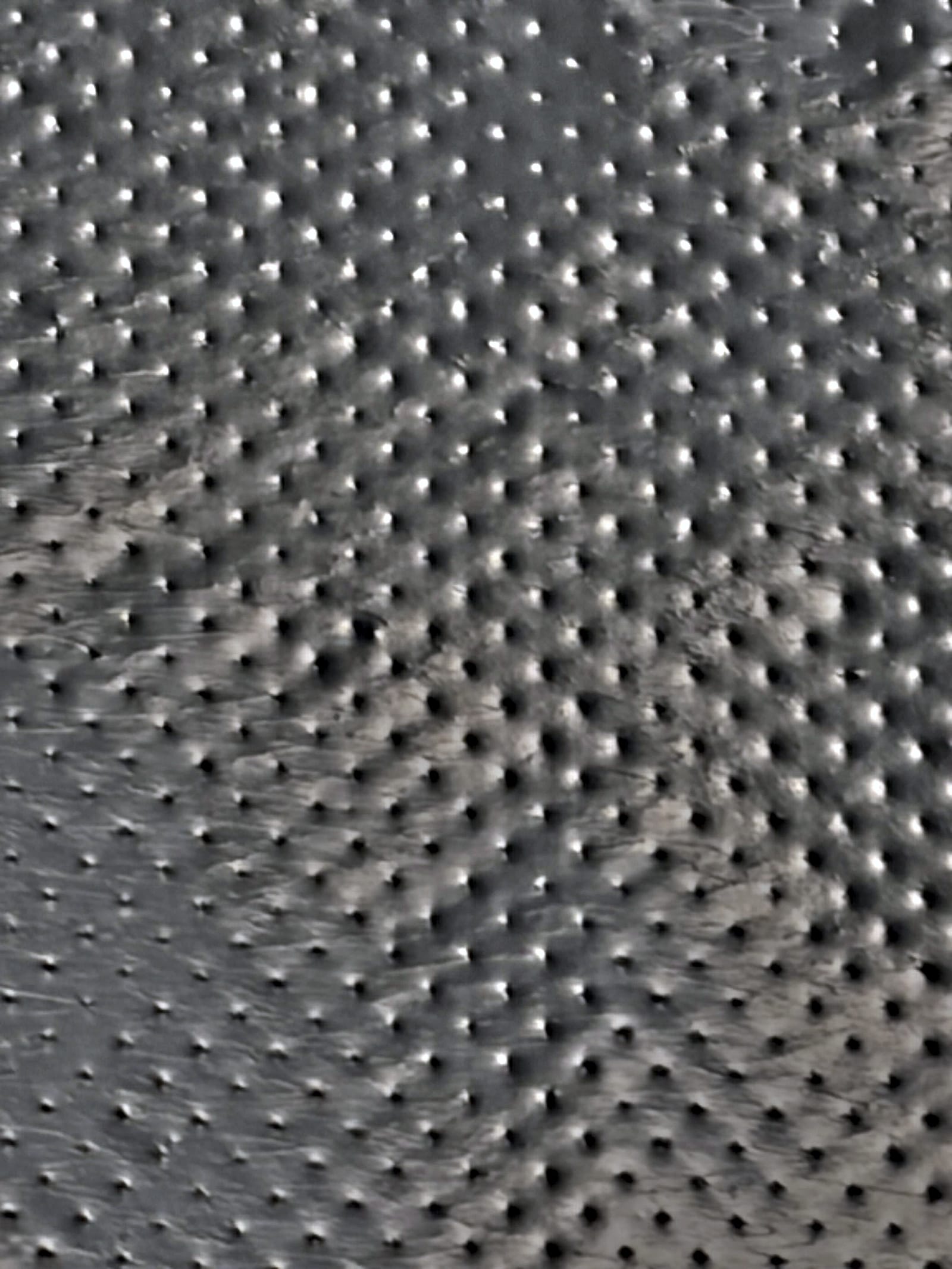
Filled poly mailers were rolling back down an apparel client's sloped conveyor because smooth polyethylene film is too slick to hold an incline; embossing a texture into the film raised the grip between bag and belt, and the roll-back stopped. The customer also reported a more premium feel, with the print unaffected.
The customer is a high-volume apparel e-commerce operation. A garment goes into the mailer, the mailer goes onto a conveyor, and the conveyor climbs to the next stage of processing. On a flat run, a smooth bag is fine. On the slope it wasn't: bags lost grip and rolled backwards. Every one of those is a parcel somebody has to retrieve and re-induct, in an operation whose whole economics rest on nobody touching a package twice.
Nobody had specced the bag wrong. It met every number on the sheet — right size, right gauge, right seal strength. The sheet just had no line for the property that turned out to matter. They came to us with the problem, not a solution: could anything be done about it?
Why smooth film slides
A parcel stays on an inclined belt because friction between the bag and the belt beats the component of gravity pulling it down the slope. Raise the incline or lower the friction and at some point the parcel loses.
Polyethylene film is naturally slick, and the things that make a mailer look good tend to make it slicker. A high-gloss finish, a smooth calendered surface, slip additives blended into the resin to stop film from blocking on the roll and to help it run through a bagger — all of them reduce surface friction. Slip additive is doing exactly what it was designed to do; it just doesn't know the difference between a converting line and a customer's incline.
So the smooth mailer isn't defective. It's optimized for a different part of its life. It runs beautifully through the machine that makes it and through the bagger that fills it, then meets a belt at an angle and gives up.
What we changed
Two things, honestly. We raised the post-consumer recycled content in the film, and we embossed a texture into it — a dense, regular pattern of raised points across the outer face, formed in the film during manufacture rather than applied as a coating afterwards.
The texture is the one with the mechanism behind it. The raised pattern gives the belt discrete contact points to bite instead of one continuous slick plane, which raises the effective grip between bag and belt. And because it's embossed into the film rather than coated onto it, it can't wear off, wash off, or scuff away in transit. It's the same material the bag is made of, in a different shape.
The roll-back stopped. Same conveyor, same slope, same operation, different surface on the bag.
The part we didn't design for
Two things came back from the customer that weren't in the brief.
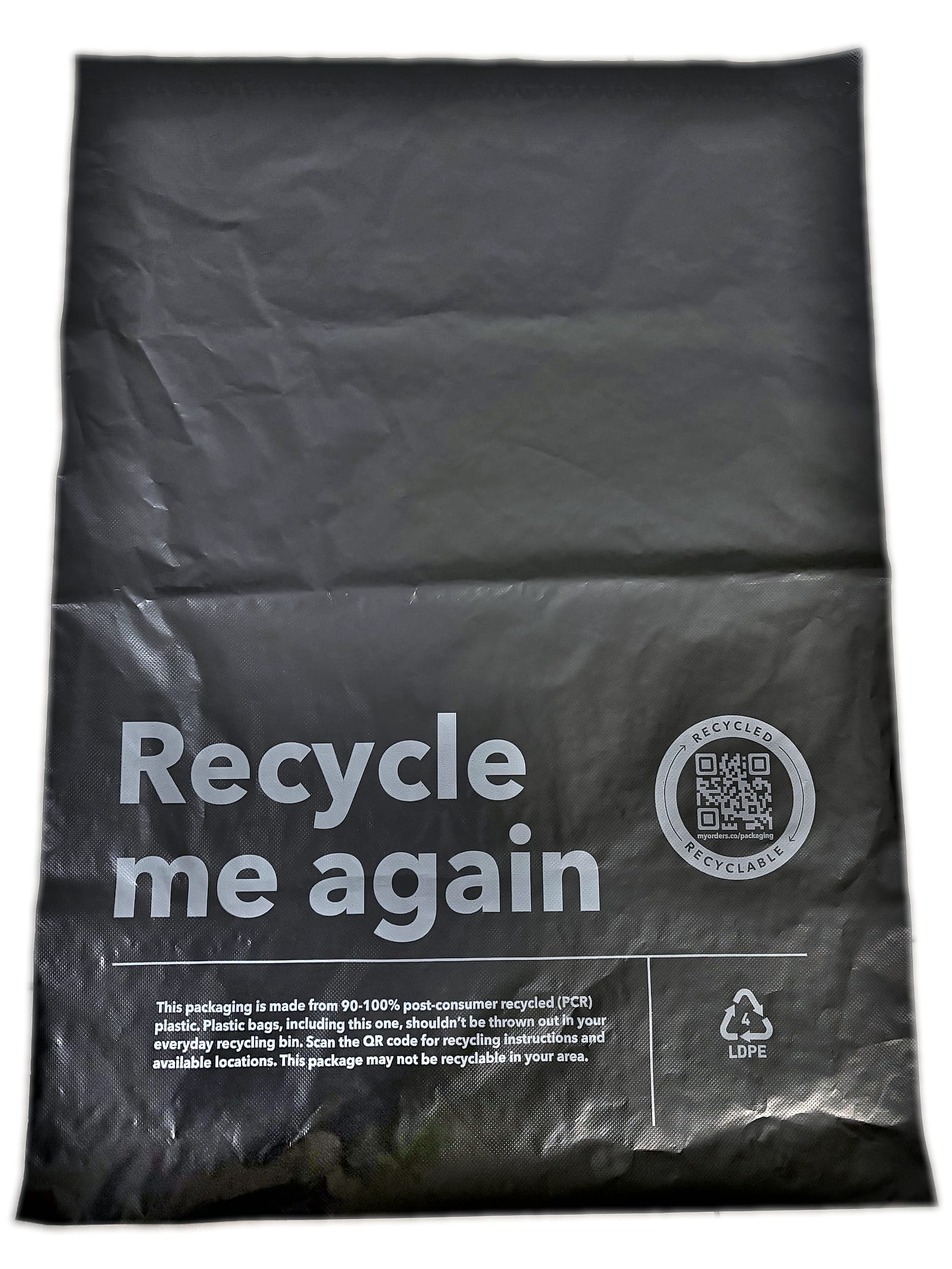
The bag feels better. They described it as more premium and more sturdy — same film, no gauge increase, purely the surface. A textured face scatters light instead of reflecting it in one sheet, and it gives the hand something to register, so the bag reads as more substantial than a gloss film of identical thickness. For an apparel brand where the mailer is the first thing a customer touches, that's not a small side effect.
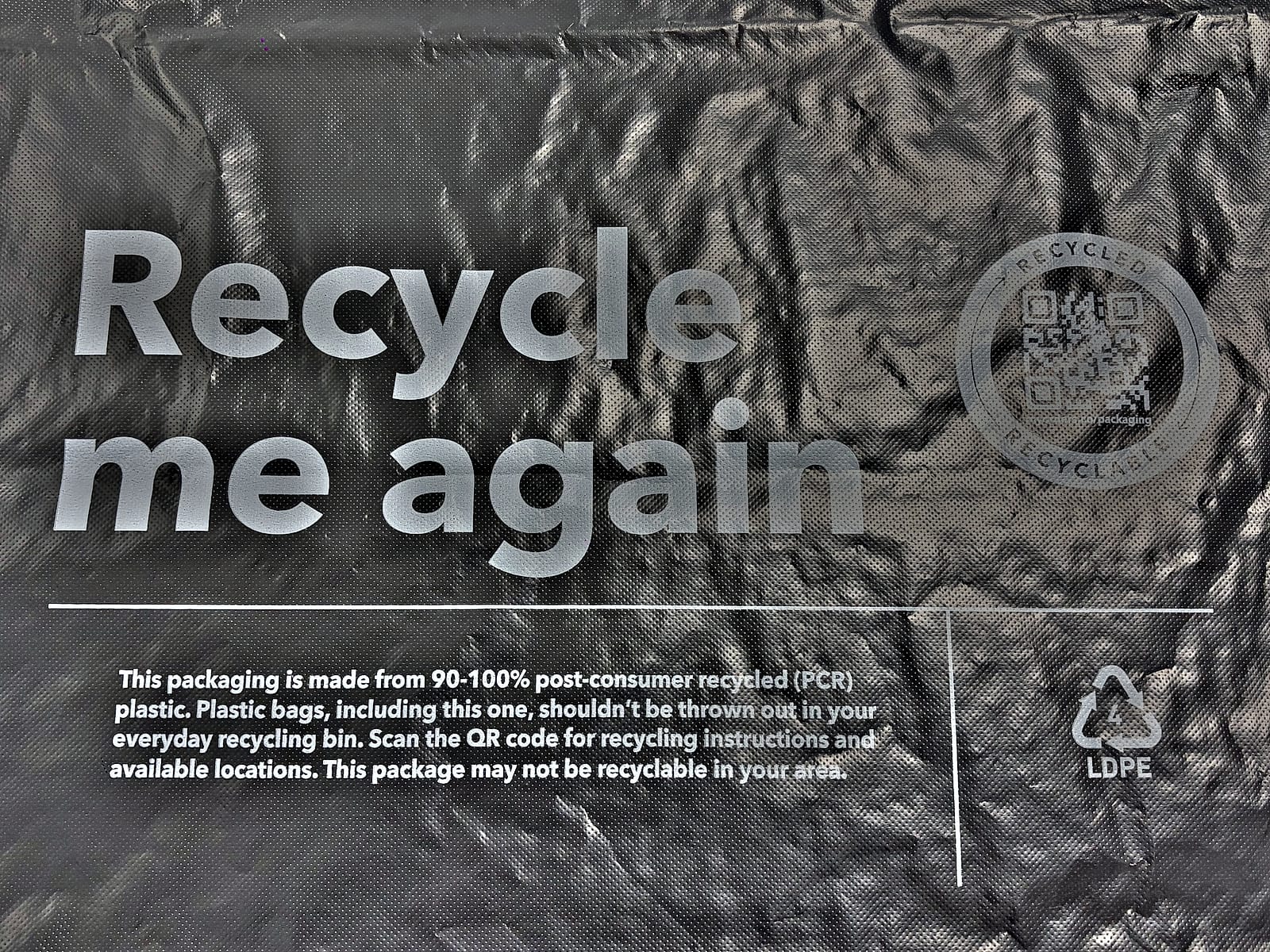
And the print was unaffected. That was the live risk going in — embossing a film you're about to print on can distort artwork or cost you edge definition. It didn't. The flexo work came through clean.
Neither of those was the reason we did it. Both are reasons the customer stayed with it.
The part worth stealing
The transferable lesson isn't "textured mailers are better." They aren't, universally — a smooth film prints with a higher gloss and is the right call for plenty of brands.
It's that surface finish is a specifiable property, and almost nobody specifies it. Buyers spec dimensions, gauge, colour, and print. Finish gets whatever the supplier's standard film happens to be, and the buyer finds out what they got when something downstream misbehaves.
If your parcels move on inclined belts, through spiral chutes, down gravity roller sections, or get stacked in totes that get carried at an angle, friction is a spec line for you. It's worth putting on the sheet next to the gauge.
What else is adjustable on a custom mailer
Because we extrude the film, print it, and convert it under one roof in Tijuana, most of a mailer's properties are decisions rather than constraints. The ones customers change most often:
- Size — cut to any width and length, not just the stock ladder. If your product sits awkwardly between two catalog sizes, the right answer is usually the size that fits, not the one that exists.
- Gauge — typically 2.0–3.0 mil for mailers, thicker where the contents are heavy or sharp. Heavier film costs more per bag and can still be the cheaper decision once damage claims are counted.
- Colour and opacity — white for a retail-facing look, black with an opaque or anti-static inner liner where contents shouldn't be visible through the bag.
- Surface finish — smooth for maximum print gloss, or embossed where grip matters. This case study is that line item.
- Print — up to six flexographic colours per side, in-house Pantone matching, printed on one or both faces. Plates are stored on file, so a repeat of the same artwork reorders on the stock timeline.
- Single or double adhesive strip — one strip seals the bag. A second strip turns it into a returns mailer: the customer reopens along the tear line and reseals with the second strip, no new packaging required.
- Tear line for returns — a perforated strip that opens cleanly by hand, so the recipient doesn't cut into the bag they're about to send back.
- Recycled content — post-consumer recycled (PCR) resin blended into the film, at the percentage the brand wants to stand behind on-pack.
How to spec this without guessing
Two practical notes if you're looking at a similar problem.
Test with the real belt. Coefficient-of-friction figures on a datasheet are measured film-to-film or film-to-steel under lab conditions, and your conveyor is neither. The only test that settles it is running sample bags, weighted the way real orders are weighted, up the actual incline that's giving you trouble.
Change one variable — and note that we didn't, here. We moved PCR content and surface finish in the same revision. It worked, and the customer is happy, but it does mean we can't hand you a clean attribution between the two; the texture is the change with a mechanism behind it, and the PCR is the change we'd have to isolate to prove. On a problem this legible that was the right trade. On a subtler one it wouldn't be, and we'd run the finishes as separate samples against an otherwise identical spec so the comparison actually tells you something.
If parcels are coming back down a belt, or a bag is failing somewhere its spec sheet never described, send us the geometry and a description of the line. Samples of the actual build, on your actual conveyor, settle it faster than any datasheet.
Frequently asked questions
- Why do poly mailers slide back down an inclined conveyor?
- Polyethylene film is naturally slick, and a high-gloss finish, a smooth calendered surface and slip additives blended into the resin all reduce surface friction further. A parcel stays on an inclined belt only while friction between bag and belt beats the component of gravity pulling it down the slope, so a smooth mailer that runs well through a bagger can still lose grip on an incline.
- How do you stop poly mailers slipping on a sloped conveyor?
- Embossing a texture into the film, a dense regular pattern of raised points across the outer face, gives the belt discrete contact points to bite and raises the effective grip between bag and belt. Because the texture is formed in the film during manufacture rather than coated on, it cannot wear off, wash off or scuff away in transit. In this case the roll-back stopped on the same conveyor and slope; post-consumer recycled content was raised in the same revision, so the texture is the change with the mechanism behind it.
- Does embossing a poly mailer affect the print?
- In this case the print was unaffected: both the display type and the six-point body copy held their edges on the embossed face because the texture is fine enough that the plate still lays ink down flat. The customer also described the bag as more premium and more sturdy with no gauge increase, purely from the surface.