



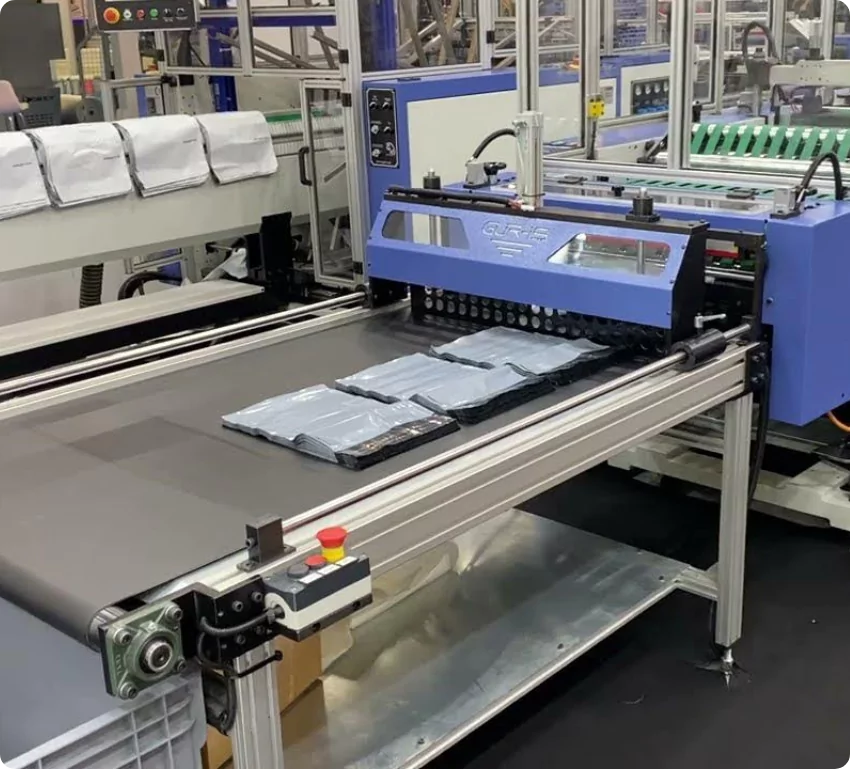
Most autobagger jams are caused by the film, not the machine: width that drifts across the roll, film stiffness that changes with the resin batch, static, and edge curl, none of which show up on the bag's spec sheet. When a 3PL's autobagger starts misfeeding three times an hour, though, the first phone call is to the bagger manufacturer, the second is to the maintenance tech, and the bag supplier is often not brought in until weeks later, when somebody finally measures the bag.
Here's what gets missed: the bag almost always passes a manual inspection. The bag opens. The flap seals. The dimensions print as labeled on the case. What it doesn't have is the width tolerance the bagger needs.
What “tolerance” means in this context
A bagger doesn't run on the labeled width of the bag. It runs on the consistent width — the standard deviation, bag to bag, across the same roll. A 9.000″ bag that runs at 9.000″ ±0.030″ all day will autofeed cleanly. The same 9.000″ bag running at 9.000″ ±0.080″ will jam every twenty minutes — even though every single bag passes the spec sheet.
Most off-the-shelf poly mailers don't publish their width tolerance, because at the gauge most catalog distributors stock — extruded on a fixed die, no inline gauge monitoring — the actual tolerance is in the ±0.060″–±0.090″ range. It's fine for a hand-pack station. It's not fine for a 90 bag/min Autobag, ePac, or Sharp tabletop bagger running 12-hour shifts.
What's actually causing the jam, in order of frequency
- Width drift across the roll. Bag #1 measures 9.000″. Bag #50,000 on the same roll measures 9.070″. The bagger's hopper centers on 9.000″ — at bag #45,000 it's misfeeding.
- Inconsistent film stiffness. Resin blend changes batch to batch. Stiffer film feeds; limper film slumps and double-feeds. This is the silent jam.
- Static. Bags cling to each other coming off the case. The anti-static spec lives in the resin formula, not in a topical spray.
- Edge curl. Cooling-tower temperature drift during extrusion produces an inside-curl the bagger's vacuum heads don't pick up cleanly.
What to ask your supplier
A vertically integrated supplier — meaning they extrude their own film and convert it on their own lines — can answer three questions a converter-only supplier can't:
- What was the gauge variation on the last lot you shipped me? They should have the inline gauge-monitor data per roll.
- What was the resin blend lot, and is it the same blend as the previous shipment? Resin substitution is the silent autobagger killer.
- Can you run a test lot at the spec you'd recommend and let us pull it on our line before we commit the production order? Custom extrusion can adjust the layer balance for stiffness without changing the dimension on paper.
If the answer is in catalog terms — “we stock 9×12, 10×13, 14×19, that's what we have” — they're not in the bagger conversation. They're in the warehouse conversation. You're going to keep paying the bagger tech $180/hr to diagnose film.
Frequently asked questions
- Why does my autobagger keep jamming with poly mailers?
- The most frequent cause is width drift across the roll: the bagger's hopper centers on the labeled width, and when bag #50,000 measures 9.070″ instead of 9.000″ it misfeeds even though every bag passes the spec sheet. The next causes, in order, are inconsistent film stiffness from batch-to-batch resin changes, static, and edge curl from cooling-tower temperature drift during extrusion.
- What width tolerance does a poly mailer need for an automatic bagger?
- A 9.000″ bag that runs at ±0.030″ all day will autofeed cleanly, while the same bag at ±0.080″ will jam every twenty minutes. Most catalog poly mailers extruded on a fixed die without inline gauge monitoring run in the ±0.060″ to ±0.090″ range, which is fine for a hand-pack station but not for a 90 bag/min bagger running 12-hour shifts.
- What should I ask my poly mailer supplier about bagger compatibility?
- Ask for the inline gauge-variation data per roll on the last lot they shipped, whether the resin blend lot is the same as the previous shipment, and whether they can run a test lot at their recommended spec for you to pull on your own line before committing the production order. A vertically integrated supplier that extrudes its own film can answer all three; a converter-only supplier cannot.