


An FBA-compliant poly bag needs four things in production: the standard suffocation warning printed at a letter size scaled to the bag perimeter on bags 5″ × 5″ or larger, a gauge of 1.5 mil or thicker, a pattern of vent holes, and an FNSKU barcode that scans while the product is inside the bag. Amazon's own policy page is short, the rejection emails are vague, and the actual production specs are spread across three different Amazon documents and one CPSC standard that none of them link to.
Here's the consolidated version, in the order it matters for an actual production run.
The four specs that will get a bag rejected
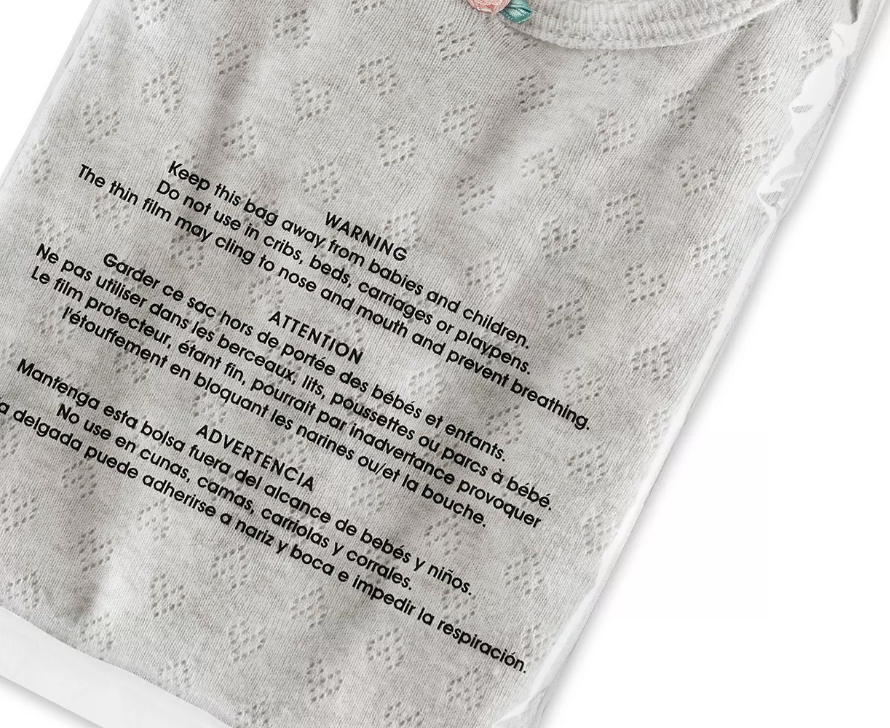
Suffocation warning print. Bags 5″ × 5″ or larger that hold a product offered for sale must carry the standard warning text: “WARNING: To avoid danger of suffocation, keep this plastic bag away from babies and children. Do not use in cribs, beds, carriages, or playpens. This bag is not a toy.” Print specifications: black text on a contrasting background, with letter size scaled to bag perimeter — roughly 24-point for bags above 25″ perimeter, 18-point for 15″–25″, and 10-point for under 15″. Bilingual (EN/ES/FR) is the safe North American default. We ship all three by default.
Gauge minimum. 1.5 mil or thicker. Below 1.5 mil the bag is considered too thin to safely carry the warning print at scale and is non-compliant. Most off-the-shelf “FBA poly bags” are 1.5 mil exactly — meaning a thin patch in the web puts that bag below spec. We default to 1.5 mil with ±0.05 mil tolerance across the web, so the thinnest point of the bag is still on-spec.
Vent holes. Required on every FBA suffocation warning bag — punched as a pattern, not a single hole, so the bag genuinely cannot inflate and hold a child's face. The punch pattern must be visible on the bag with contents inside. We use a 6-hole pattern on the back face, 1/8″ diameter, scaled to the bag size.
Barcode placement and FNSKU readability. The product's FNSKU barcode must be scannable while the product is inside the bag. That means: the barcode is printed on the outside of the warning bag (not on the product inside), it is not obscured by the suffocation warning print, and it has a quiet zone of at least 1/4″ on each side. Most rejections we diagnose come from FNSKU barcodes that landed on top of the warning print at the prep center — scannable in isolation, unreadable as a composite.
The five specs Amazon doesn't tell you but prep centers will
- Bag-to-product fit. The bag should be just larger than the product, not significantly larger. A 14×20 bag around a 4×6 product is a flag — Amazon's image team marks it for review.
- Self-seal vs heat-seal. Either is compliant, but if the product is anywhere near food (supplements count, even if bottled), the self-seal adhesive must be FDA-compliant for indirect food contact.
- PCR content claims. If the bag print claims post-consumer recycled content, the content must be third-party verified. Amazon doesn't audit it — but California's SB 343 (effective for marketing claims from 2026) does.
- Lot traceability per bag. Not required by Amazon. Required by your insurance underwriter, your CPSC compliance plan, and any class-action lawyer who shows up after a baby-suffocation incident. We print a roll number on every bag — small, in the bottom corner.
- Country of origin. Required on the case, not the bag. “Made in Mexico / Hecho en México” with USMCA-compliance documentation in your supplier file.
The one enforcement rule Amazon recently added that nobody is talking about
As of early 2026, Amazon has been enforcing a previously-unwritten rule: the suffocation warning print must remain legible after the bag has been compressed inside a shipping carton. The practical version — the warning print needs to be high enough on the bag that compression wrinkles don't land on it.
Most cheap FBA bags print the warning low on the face, where it crumples in transit. The rejections from this rule show up as “non-compliant warning print” with no further explanation, and the brand spends a week trying to figure out what changed. Nothing changed in the spec — Amazon's image audit got smarter. We default to print in the upper third of the bag where compression-induced wrinkles rarely land.
Five questions to ask your supplier
- Can you print the warning in EN/ES/FR by default, even if I only need EN?
- Are your bags 1.5 mil with ±0.05 mil tolerance, or 1.5 mil with ±0.10?
- Do you punch vent holes inline, or as a separate post-conversion step?
- Can you provide a country-of-origin certificate per case?
- Do you maintain lot traceability that I can pull if CPSC asks?
A “yes” on all five is table stakes for a 2026 FBA supplier. The catalog distributors will tell you “the bags are FBA-compliant” — that's the marketing answer. The five questions above get you to the production answer.
Frequently asked questions
- What are the Amazon FBA poly bag requirements?
- An FBA poly bag must carry the standard suffocation warning if it is 5″ × 5″ or larger, be 1.5 mil or thicker, have vent holes punched as a pattern rather than a single hole, and keep the FNSKU barcode scannable on the outside of the bag with a quiet zone of at least 1/4″ on each side. Warning letter size scales with bag perimeter: roughly 24-point above 25″ perimeter, 18-point for 15″–25″, and 10-point under 15″.
- Why is Amazon rejecting my poly bags for non-compliant warning print?
- As of early 2026, Amazon has been enforcing a previously unwritten rule that the suffocation warning print must remain legible after the bag has been compressed inside a shipping carton. Bags that print the warning low on the face crumple in transit; printing in the upper third of the bag, where compression wrinkles rarely land, avoids the rejection.
- Does the FNSKU barcode go on the bag or on the product for FBA?
- The FNSKU barcode must be printed on the outside of the warning bag, not on the product inside, and it must be scannable while the product is in the bag. It cannot be obscured by the suffocation warning print and needs a quiet zone of at least 1/4″ on each side; the most common rejection we diagnose is a barcode that landed on top of the warning print at the prep center.