



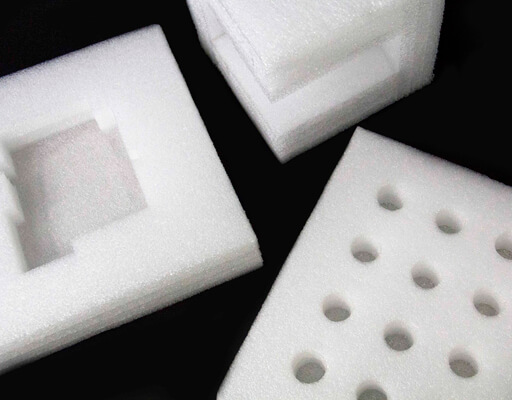
Bubble and air pillows cushion surfaces. Foam does something they can't: it absorbs real impact and immobilizes the product so it can't move inside the box at all. For anything fragile, rigid, heavy, or high-value — electronics, instruments, medical devices, glass, machined parts — that immobilization is the difference between a product that arrives and a damage claim.
Foam is also the part of protective packaging buyers understand the least, because it comes in more forms and materials than film does. Here's the map.
The forms
- Corner and edge protectors — guard the corners and edges that take the hit when a box is dropped or stacked. The cheapest foam insurance there is.
- Cavity inserts — foam cut to the exact shape of the product, so it sits in a pocket and can't shift. The premium form: engineered, snug, repeatable.
- U-channels — slide onto a panel or edge (glass, displays, furniture) to protect a long run in one piece.
- Planks and sheets — flat foam for layering, dividers, surface protection, and as the stock you cut inserts from.
- Tubing and rods — protect cylindrical parts, shafts, and tubes; or fill voids.
The materials (and when to use each)
- Polyethylene (PE) foam — the workhorse. Closed-cell, durable, reusable; good cushioning for medium-weight goods. The default for inserts and corner protection.
- Anti-static (ESD) PE foam — PE with a static-dissipative additive (often pink). Required for electronics and any product with exposed circuitry. See our separate piece on ESD foam.
- Polyurethane (PU) foam — soft, open-cell, conformable. Cradles delicate or irregular items; the classic “egg-crate” and convoluted foam.
- Expanded polystyrene (EPS) — rigid, very light, inexpensive. Great for lightweight rigid protection and thermal; not for repeated impact.
- Cross-linked (XLPE) foam — fine, uniform closed cell. Premium look and feel, clean cut edges; for high-value products where presentation matters.
Engineered vs. stock foam
Stock foam — sheets, rolls, generic corner pieces — protects in a general way and is fine for forgiving products. Engineered foam is cut to your specific product on CNC, hot-wire, or die-cutting equipment, so the product drops into a pocket that fits it exactly. That precision is what immobilizes a heavy or fragile item and lets it pass a drop and vibration test, and it's what a stock block can't do.
The trade is setup: engineered foam needs a design and a cut program, so it carries a one-time engineering step that stock foam doesn't. For a product that ships in volume or can't afford a damage rate, that setup pays for itself fast.
Do you even need foam? The one question
Ask: when the box is dropped or stacked, what fails? If the answer is a scuffed surface, bubble or a bubble bag handles it. If the answer is a cracked, dented, or knocked-out-of-alignment product — something that needs to not move and to absorb a real hit — that's foam, and usually engineered foam.
Weight and value push the same way. The heavier and more expensive the product, the more the immobilization matters and the cheaper the foam looks next to a single damage claim.
Questions to ask a foam supplier
- Can you engineer a cavity insert to my product, or only sell stock shapes?
- Which material do you recommend for my weight and fragility — and why that one?
- If it's electronics, is the foam genuinely anti-static / ESD-rated, with a surface-resistance spec?
- Can you cut a sample and let me drop-test it before I commit to a production run?
- What's the lead time, and does it change on reorders once the cut program exists?
Frequently asked questions
- When do you need foam packaging instead of bubble wrap?
- You need foam when a dropped or stacked box would leave the product cracked, dented, or knocked out of alignment, not just scuffed. Bubble or a bubble bag handles surface scuffs; foam absorbs real impact and immobilizes the product so it cannot move inside the box, and the heavier and more expensive the product, the more that immobilization matters.
- What is the best foam for protective packaging?
- Polyethylene (PE) foam is the default for cavity inserts and corner protection: closed-cell, durable, reusable, and good cushioning for medium-weight goods. Use anti-static PE for electronics and exposed circuitry, polyurethane (PU) to cradle delicate or irregular items, expanded polystyrene (EPS) for lightweight rigid or thermal protection, and cross-linked (XLPE) foam when presentation and clean cut edges matter.
- What is the difference between engineered foam and stock foam?
- Engineered foam is cut to your specific product on CNC, hot-wire, or die-cutting equipment so the product drops into a pocket that fits it exactly, while stock foam is generic sheets, rolls, and corner pieces that protect in a general way. Engineered foam carries a one-time design and cut-program step, which pays for itself for a product that ships in volume or cannot afford a damage rate.